
Remembering Karl Weick
Friends, colleagues, and collaborators remember a former editor whose scholarship, mentorship, and humanity helped define ASQ and organization theory for decades


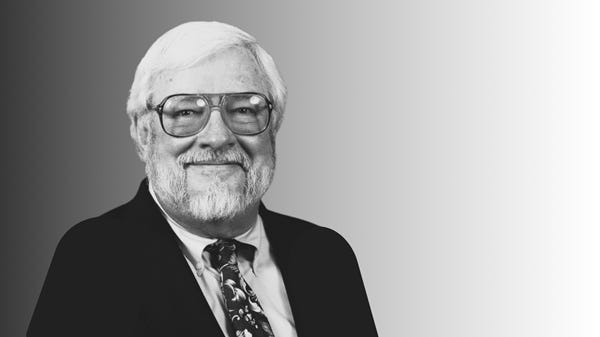
IN MEMORIAM: KARL E. WEICK
(October 31, 1936 – May 21, 2026)
ASQ Editor 1977–1985
Karl Weick’s influence on ASQ and on the people in the field of organization theory who count him among their intellectual exemplars has been profound. We asked some of his colleagues and friends from ASQ, his university department, and the broader field to offer short tributes here as encouragement for all who knew him or his work to actively remember the gifts he shared. To the reflections below, we add this: Karl was involved in ASQ for decades after his editorship concluded, and among the staff and editorial team members, his kindness was legendary. His unwavering support, generous praise, and “Big hugs” offered at the close of emails shaped this journal’s community in countless ways. We are grateful for all of them.
Kathleen M. Sutcliffe
(Johns Hopkins University, University of Michigan)
In 1999 Karl Weick was asked to opine on “The Discussant Role” in an AOM Annual Meeting PDW titled “How to Make AOM Sessions More Exciting.” He started his remarks with a realistic job preview, noting that if you’re the discussant (1) “you’ll get none of the papers in advance”; (2) “there will be no time left for you to make your comments”; (3) “if time is left you’ll be introduced as the person who will pull it all together”; (4) “the audience wants you to sit down so they can ask their questions”; and (5) “it is fun to do because you have a chance to spot connections and you don’t have to scramble to write a quasi-paper during the December holidays to get a slot at the annual meeting.”
Karl had a keen sense of humor. But of course, that isn’t all.
To pay tribute to Karl Weick is to speak about a mind that reshaped how we understand organizations. He changed the questions we ask. Where others asked how organizations make decisions, allocate resources, or process information, Karl asked something more unsettling—how do people figure out what is happening at all? His move from “organization” to “organizing,” from nouns to verbs, from structure to process, reoriented organization studies and gave scholars permission to take interpretation, ambiguity, and meaning seriously as objects of scientific inquiry.
Over the almost forty years we worked together—as colleagues, collaborators, and friends—Karl’s clear thinking, imagination, and generous spirit continually expanded my own ways of seeing. Among the many ideas we developed together, I return most often to our shared interest in the quality of attention. For Karl, attention was never a cognitive resource to be managed; it was an action—a deliberate way of meeting the world. And he enacted that belief in the day-to-day. Karl listened the way he taught us to pay attention—fully, without scanning the horizon for something more interesting. He offered presence as a form of respect. Relatedly, impermanence is another theme that runs through his work. Because organizations, interpretations, and identities are always shifting, he saw attentive noticing as a way of honoring the transient—an act of staying present to a world in motion.
And perhaps that explains his enduring influence. In a world defined by impermanence, Karl showed that what we choose to notice can leave a lasting mark.
And I carry that forward.
Susan J. Ashford
(University of Michigan)
Scholars entering the field in the 1980s, and so many since, looked up to Karl Weick as an intellectual giant who shaped our field in profound ways. He was an iconic editor of Administrative Science Quarterly and his seminal book, The Social Psychology of Organizing, was an absolute treasure trove of ideas that continues to be mined for new insights to this day. One of the things I love about Karl’s scholarship is that both macro and micro scholars draw deeply from it. Whether it’s his foundational ideas on sensemaking or his famous “Drop your tools” article based on the book Young Men and Fire, his concepts have guided macro scholars helping firms move toward new strategies, as well as micro scholars helping individuals adapt to changing situations. Long before the idea was popularized, Karl intuitively understood how to make messages “sticky.”
I was fortunate to call Karl a colleague for more than 20 years at the University of Michigan. We gathered for book club meetings at his house, received a “first look” at his emerging ideas during seminars and university lectures, and marveled at how someone so deeply intellectual could also teach executive audiences with great success! Those who only know Karl through his writing often miss his other defining quality, his kindness. There I was, a brand-new professor at Michigan, and it was Karl Weick, an international academic celebrity, who reached out to me frequently just to make sure I was okay and check whether I needed anything! He was an intellectual giant, an incredibly creative scholar, and a deeply kind colleague. He will be greatly missed.
Michael G. Pratt
(Boston College)
Karl and I began at the University of Michigan at the same time. I have a few “flashbulb” moments that I cherish. My first meaningful interaction with him was when I, as a new doctoral student in organizational psychology, wandered into the new faculty members’ office to see how he was doing as a fellow newcomer. I admit, I was mostly clueless to who Karl was. Yet, he was appreciative of my intent, and gracious and open about his experiences. He never seemed bothered by either my visit or my ignorance of his work.
I later had the privilege of taking a course from him entitled “The Craft of Scholarship.” The lessons learned there would be too numerous to recount here. However, I vividly remember walking with him to his office after a class when he shared some of his own life, and some of the troubles and challenges he endured in the early parts of his adulthood. He had planned to discuss all of this in a book chapter. I asked him if he had any concerns about sharing this information with a wider audience—people may not want to know the flaws of their heroes, after all. He was initially taken aback by the question, but quickly noted that the whole point of the revelation was to remind people that we are all imperfect human beings. The conversation that followed revealed not only his humility, but his humanity. This is something I think we can forget if we just look at intellectual giants like Karl as “the Karl Weick.”
Over the years, Karl became my academic advisor and eventually a member of my dissertation committee. During our conversations about what intellectual questions were driving my studies, he suggested a book, Commitment, Conflict, and Caring, that not only deeply influenced my thinking and writing but also sparked a lifelong interest in ambivalence. Although his writing on sensemaking continues to shape my own (and many others’) work, it was these moments of graciousness, humility, and curiosity that point to another of his legacies: modeling (enacting) the virtues a scholar should embody.
Henry Mintzberg
(McGill University)
I didn’t know Karl when I first encountered him. He was the rather young editor of Administrative Science Quarterly who decided to do Book Review Essays, beyond the usual brief book reviews, and introduced this with my first book, just published. With that essay, Karl made my career.
Needless to say, I became a fan, for good reason! But how about all the other fans? They had all kinds of better reasons. Karl probably had the largest, and most enthusiastic, fan club in the academic world of Organization Theory. When he spoke at a conference, we attended, if we could get in. When he published, we read, never knowing what in the world of organizations was coming next, except that it was bound to expand our understanding of it. A disastrous forest fire, jazz musicians, “Mindful Moments in a Mindless Organization”: with so many of today’s journal titles so convoluted, how could anyone not be charmed by this one? Karl always made his own good sense.
Of course, Karl was a physical and emotional presence too, not only in stature and beard, but in empathy. His CV lists 83 book reviews! I dug out the last correspondence I had with him, in 2021, when I asked if we could nominate him for an honorary degree at McGill. He was unable to travel, he said, but replied with such warmth that I wrote back: “This is the nicest no I ever received, Karl!”
We have many colleagues in academia whom we respect, even admire. But how many do we revere? So thank you Karl for all that you have enacted, leaving us with a wonderful selection of ideas and experiences that we will retain with great gratitude.
Howard E. Aldrich
(University of North Carolina, Chapel Hill)
I have two enduring memories of Karl’s editorship of ASQ. First, in 1975–76, while I was in Europe on a sabbatical, I was serving as the associate editor by long-distance mail. I noticed that the flow of manuscripts slowed drastically during the year but didn’t know why. When I returned to Cornell, I saw the reason: The then-editor had allowed huge stacks of unread manuscripts to pile up on the shelves! I learned that a group of concerned academics had petitioned the dean to do something. Karl was asked to take over, and he stepped into a quagmire of unreviewed papers and submissions that had been waiting months for decisions. He saved ASQ with what amounted to a heroic rescue mission. Few people knew of Karl’s sacrifice, and I don’t think he ever talked about it with outsiders.
Second, Karl regularly held editorial staff meetings, with associate editors like Lou Pondy and then Gerry Salancik flying in for them. But I learned much more about Karl’s way of thinking through students—business school students taking my organization theory class, and ILR and sociology students taking Karl’s theory class. Students would tell me, “but Karl says that . . .” and I would thus learn about new directions in his thought. For example, it was through them that I learned about his enthusiasm for Henry Mintzberg’s book on managerial work. Lance Kurke, one of Karl’s students, collaborated with me on a project to replicate Mintzberg’s findings. Eventually, Karl and I would talk about some shared interest, and he’d say, with apparent surprise, “Now I understand why you see it that way.” Which, usually, was not the way he saw it. And that’s how I learned what he thought.
Gerardo Patriotta
(University of Bath)
Karl Weick arrived at our meetings with a reporter’s notebook. He would ask questions, listen carefully, and take notes, as if he were an apprentice rather than a master. Humble, generous, and driven by intellectual curiosity rather than the desire for fame, he never advertised his work. Citations, he used to say, would take care of themselves. He had followers, but never actively sought to build a following. The sensemaking community grew spontaneously, finding in his work the concepts and questions it needed. It was, in his own terms, a loosely coupled community, held together by shared ideas rather than by any ambition to formalize a school of thought.
Karl was arguably the first scholar to develop a fully process-based view of organizing, introducing such concepts as sensemaking, enactment, loosely coupled systems, the management of the unexpected, mindfulness, and improvisation. Beyond their theoretical reach, these concepts endured because they were delivered in prose of rare distinction. Karl was a maverick writer, evocative and imaginative, alive to the texture of experience in a way rarely found in academic work. His vivid account of the Mann Gulch disaster is for many of us the finest piece of writing ever published in organization studies—unconventional, deeply humane, and theoretically inexhaustible. For Karl, the text was the theory, and his best writing captured, with rare precision, what it means to lose one’s footing in the world.
Karl once wrote to me that everything is heartbreaking, in retrospect. We understand that more fully now.