


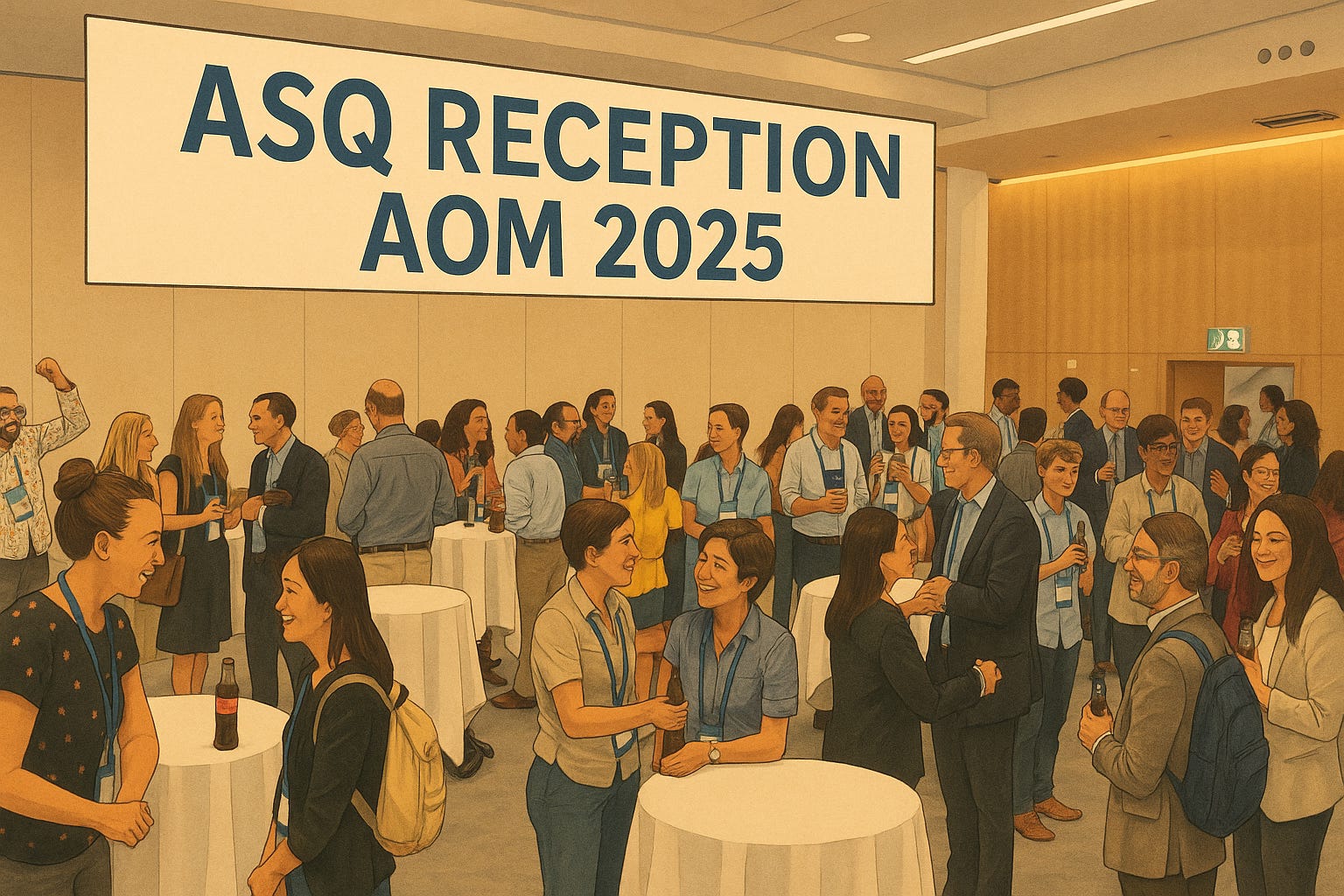
2025 ASQ Article Award Winners
Each year, we present two article awards. The ASQ Award for Scholarly Contribution honors the article published five years earlier that has subsequently had the greatest influence on the field of organization studies. The ASQ Dissertation Award goes to an article published in the previous year based on a dissertation, with the lead or sole author being the dissertation author. The award-winning dissertation article is the one that best exemplifies the criteria for publication in ASQ. Two committees, comprising members of our editorial board, review articles published during the target years and choose the award winners.
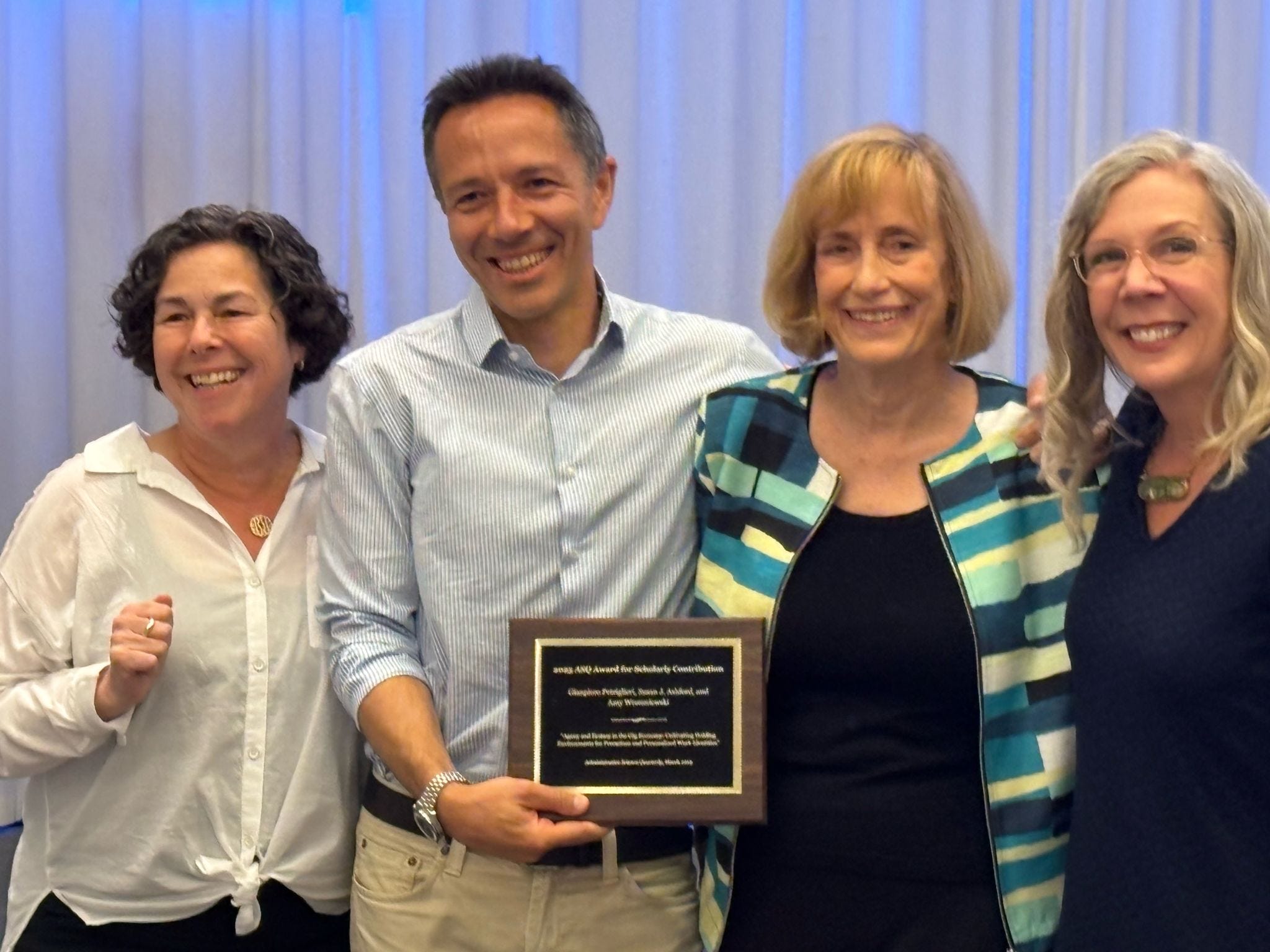
We are thrilled to share that this year’s ASQ Award for Scholarly Contribution goes to Gianpiero Petriglieri, Susan J. Ashford, and Amy Wrzesniewski for “Agony and ecstasy in the gig economy: Cultivating holding environments for precarious and personalized work identities.” The committee found this to be an “agenda-setting study” of the emotional dynamics of gig workers and how they sustain and manage work identities in the absence of traditional organizational support. With rich qualitative data and compelling quotes, the article focuses on how workers create what the authors term a “personal holding environment” by establishing connections to routines, places, people, and purpose to manage the challenges and emotional tensions of precarious work. The article combines micro/social-psychological perspectives with macro/sociological theories to explore how precarious work can be not only tolerable but also generative, and it has opened new research areas on the precarity of the gig economy and workers’ experiences within it.
Of the 15 articles published in 2024 that were based on dissertation research (out of 24 total articles we published that year), the 2025 ASQ Dissertation Award goes to Leandro S. Pongeluppe for “The allegory of the favela: The multifaceted effects of socioeconomic mobility.” Using the setting of Brazilian favelas, or urban slums, Pongeluppe’s article explores the promise of entrepreneurship as a way out of disenfranchised economic situations—and the accompanying roadblocks to social mobility. Observing results of a randomly employed business training program, Pongeluppe shows that entering formal markets increases the felt social stigma of being from a favela. The higher the income levels achieved through these programs, the more intense the adverse social-psychological effects. Pongeluppe highlights the social-psychological costs that participants, attempting to realize economic outcomes, experienced when interacting with higher-status others outside of favelas. The committee commends this article as “a wonderful example of a multi-method approach to both highlight a pattern and pinpoint the mechanisms through which this pattern is reinforced. This could not be done without thoughtful theorizing in conjunction with these methods—an exemplary abductive paper.”
We also honor the runner-up for the ASQ Dissertation Award, Michael Y. Lee’s “Enacting decentralized authority: The practices and limits of moving beyond hierarchy.” This rich, fascinating ethnographic study focuses on an effort to shift from traditional hierarchical authority to a self-managing structure under what many people now call Holacracy. Drawing on 18 months of extensive interviews, observations, and archival materials, Lee shows how decentralization is an ongoing process that must be constantly enacted to avoid backsliding into hierarchy. He identifies three key practices that employees use for bounding and grounding authority by clarifying decision rights and depersonalizing power, thereby empowering employees to act outside conventional chains of command. At the same time, Lee highlights the practical and psychological frictions that make these practices difficult to sustain. Lee argues that authority is something organizations and their members actively do rather than statically have, reinforcing that even when formal systems permit decentralization, tendencies toward hierarchy repeatedly reassert themselves.
We thank the ASQ Award for Scholarly Contribution Committee, chaired by Elizabeth Pontikes and composed of Russell Funk, Arvind Karunakaran, and Kisha Lashley. We also thank the ASQ Dissertation Award Committee, chaired by Oliver Hahl and composed of Callen Anthony, Justin Frake, and Minjae Kim. Each committee member dedicated substantial time to reading and deliberating on the contenders, and their efforts led to outstanding selections.
Leo Pongeluppe recently published a blog post in Sage Perspectives about lessons he learned while transforming his dissertation research into successful journal articles. We’re happy to reprint that terrific blog post below!
From Dissertation to Publication: Seven Lessons from the Field
By Leandro S. Pongeluppe
Transforming a dissertation into a journal article is not just about running regressions, citing classic papers, and trimming the word count – it involves clarifying your work’s contribution, sharpening the methods, and speaking to a broad community aiming to create societal good. I am honored to share lessons I learned – some more painful than others – while getting my dissertation published in Administrative Science Quarterly.
1. Focus on what you are passionate about.
The Ph.D. journey is long, and sustained motivation is difficult, especially when you are away from home, family, and friends. Transform these hardships into something meaningful to you! I anchored my research on issues I genuinely care about: the UN’s Sustainable Development Goals. My research question – whether business capabilities training can promote the socioeconomic advancement of disenfranchised individuals living in Brazilian slums, or favelas (Pongeluppe, 2024, p. 619) – was interesting to me not only as a scholar but as someone seeking to understand how people face socioeconomic inequality and can move out of poverty.
2. Follow strong role models.
Rather than trying an entirely new approach, learn from rigorous studies in your field. I benefited from authors (e.g., Attanasio, Kugler, & Meghir, 2011) who had performed randomized control trials (RCTs) and made their data and analysis code publicly available. This helped me understand not only the final product but also how data was collected and analyzed. Modeling best practices from high-quality research helped me elevate the design of my dissertation and refine its narrative for publication.
3. Collaborate.
Instead of designing an intervention from scratch, I partnered with a long-standing NGO, now called Instituto da Providência, which had over 15 years of experience delivering business training programs in Rio de Janeiro’s favelas. They brought institutional memory, a well-established intervention design, and organized historical data; I contributed an impact evaluation of their program. This collaboration saved time, reduced costs, and embedded the research in a vivid context.
4. Mix your methods.
I get annoyed with some economist friends who claim that they understand the world by only running regressions. Take the opportunity to go to the field, talk to people, and get your hands a bit dirty (Hirsch, Michaels, & Friedman, 1987). While the backbone of my study was a stratified RCT, I complemented it with computational text analysis of participant feedback, field visits, and interviews with community leaders and entrepreneurs. This triangulation helped me not only to understand my results better but also to explore the mechanisms behind them. Multiple methods enrich the data and your story.
5. Know your data and do your job.
Working with primary data brings both freedom and responsibility. I was meticulous in documenting each step of the process, from pre-registration to making data, code, and legal documents available. Knowing your data means being able to respond confidently to reviewers and make adjustments during revision. Scientific rigor is not optional – it is your best ally in the publication process.
6. Count on your scholarly community.
It takes a village to get to publication. Supervisors (Anita McGahan in my case) and committee members will guide you. Peer doctoral students will help you with ideas and execution. Editors (Chris Rider in my case) and referees will support you in crafting your contribution and making the most of your work. Their feedback, while sometimes daunting, can clarify your paper’s contribution and improve its quality. More importantly, they force you to refine your ideas and grow as a scholar.
7. Think beyond academia.
Do not limit yourself to publishing in a scientific journal. The program I evaluated was later expanded into public policy across 23 municipalities in São Paulo State, reaching over 12,500 women who lead single-parent households. The published article may have been the academic endpoint, but it was not the end of the work. We have a world to care for. Science can and should contribute to it.
A dissertation is a personal and intellectual adventure full of ups and downs. My hope is that I’ve offered encouragement – and practical guidance – as you take the next step. Keep working hard, and good things will happen!
References
Attanasio, O., Kugler, A. D., & Meghir, C. (2011). Subsidizing vocational training for disadvantaged youth in developing countries: Evidence from a randomized trial. American Economic Journal: Applied Economics, 3, 188–220.
Hirsch, P., Michaels, S., & Friedman, R. (1987). “Dirty hands” versus “clean models”: Is sociology in danger of being seduced by economics? Theory and Society, 16, 317–336.
Pongeluppe, L. S. (2024). The allegory of the favela: The multifaceted effects of socieconomic mobility. Administrative Science Quarterly, 69, 619–654.
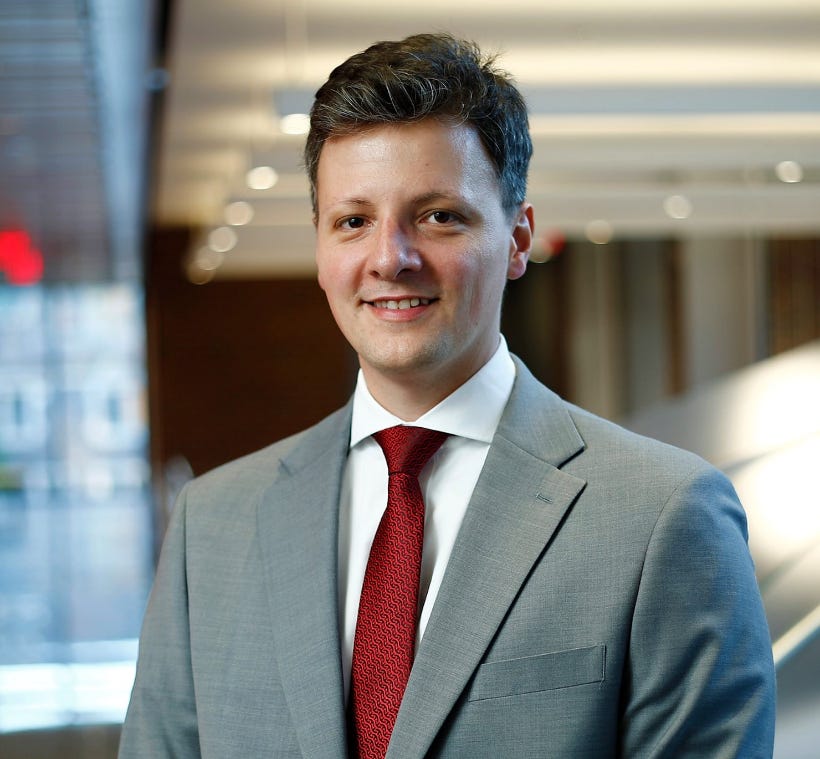
Leandro S. Pongeluppe is a socio-environmental impact specialist and an assistant professor at the Wharton School, University of Pennsylvania. Leandro holds a Ph.D. from the Rotman School of Management, University of Toronto. His primary research interests are related to stakeholder management and socioeconomic development. Particularly, Leandro is interested in understanding how organizations’ design and governance affect the achievement of the United Nations’ Sustainable Development Goals, such as poverty alleviation, environmental conservation, and health care.
Meet ASQ’s Editorial Team
This summer has been a transition time for ASQ’s editorial leadership. We offer huge thanks to these three hardworking scholars, whose terms recently ended, for their outstanding service to the journal and the field: Christine Beckman, András Tilcsik, and Siobhan O’Mahony:


And a hearty welcome to our newest associate editors: Matthew Bidwell, Fabrizio Ferraro, and Ruthanne Huising:


Matthew, Fabrizio, and Ruthanne join an outstanding team consisting of associate editors Emily Bianchi, Seth Carnahan, Stéphane Côté, J.P. Eggers, Greta Hsu, Olenka Kacperczyk, Erin Reid, Amanda Sharkey, and Dan Wang, with leadership from deputy editor Adam Kleinbaum and editor Beth Bechky. Each member of our editorial team devotes countless hours to the work of assessing submissions, running the peer review process, making (often tough) decisions, and ensuring that the journal’s policies and processes keep up with ever-changing needs.
Many thanks to every one of them for their dedication!